A road sign does more than display a destination or instruction: it gives drivers time to detect a hazard, choose a lane, reduce speed, and act without sudden manoeuvres. By the end, you will be able to distinguish sign types, judge placement and legibility, and specify a system that remains clear in daylight, darkness, bad weather, and equipment failure.
Key takeaways
- Place signs before decision points, not inside the conflict area.
- Limit each sign to the instruction drivers need next.
- Use retroreflective materials and test visibility at night.
- Specify mounting height, sight distance, symbols, lighting and maintenance access.
How road signs control risk, not just convey information
A road sign controls traffic safety by changing what road users do before conflict occurs: it reduces speed, exposes a hazard, assigns a lane, provides pedestrian protection, or gives drivers time for junction decision-making. Its shape, colour, symbol and position create an instruction system that can be recognised under pressure, not merely read as advertising.
- Regulatory signs set legal controls such as speed limits, no-entry rules and turn restrictions.
- Mandatory signs require a movement, such as keeping left or using a marked lane.
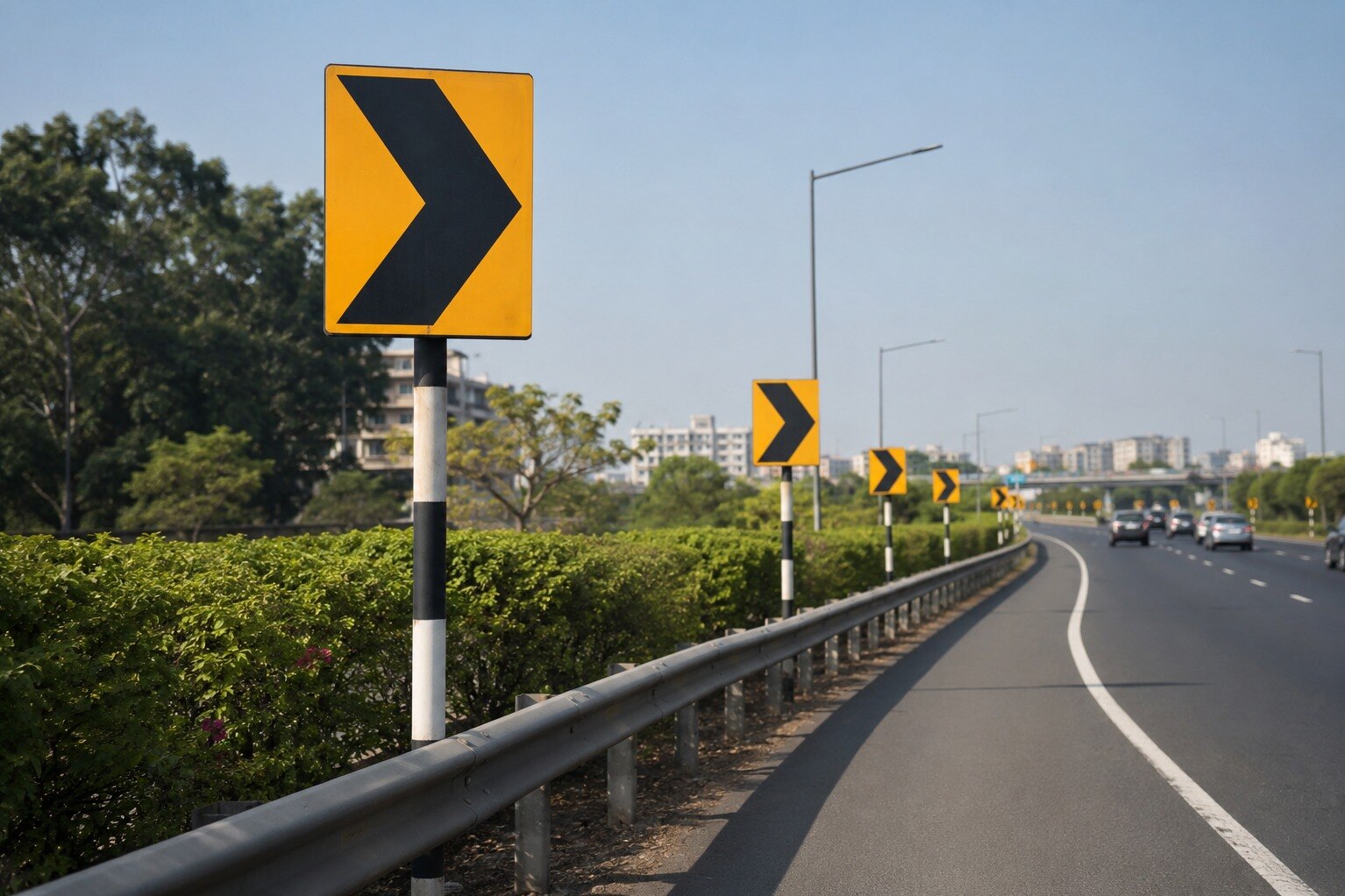
- Warning signs announce hazards early enough for braking or a safer lane choice.
- Directional signs guide route selection; late placement causes sudden braking or lane changes.
- Informational signs identify facilities or road conditions without ordering a manoeuvre.
- Parking signs control stopping space and restrictions near crossings, corners and access points.
- Temporary work-zone signs show lane shifts, workers and changed surfaces through dust and shifting sight lines.
- Emergency-exit signs direct people away from danger when normal routes are blocked.
Clutter turns recognition into a safety risk: logos, phone numbers, extra arrows, excessive brightness, animation and scrolling make drivers search longer. Keep LED messages short and stable, separate branding from safety guidance, and place directions before the junction for braking and lane choice. Public-road installations need approval from the road-owning authority.
Where signs belong and how much information drivers can absorb
Place a sign far enough before the decision point for drivers to notice it, read it, choose the correct path and manoeuvre safely. The required advance-warning distance increases with traffic speed, poor weather, night-time visibility and complex junctions. A directional sign installed exactly at a turn forces late braking or a sudden lane change.
Check the placement against the road, not against the property boundary:
- Set the sign mounting height and lateral clearance according to the road-owning authority’s rules for that road type. Urban streets, highways, footpaths and private premises do not share one safe dimension.
- Turn the sign face to match road orientation and prevent reflection from headlights or low sun. A twisted face can become unreadable even with good materials.
- Maintain sign spacing so one message can be understood before the next enters the driver’s visual field. Clustered signs create visual clutter and delay recognition.
Design each face for its expected viewing distance. Letter height must remain readable without forcing drivers to look away from traffic; use a simple font, strong contrast and a symbol size that remains recognisable at speed. Remove extra destinations, logos, phone numbers and decorative wording when they compete with a safety-critical instruction.
Separate commercial branding from regulatory, warning and directional signs. Public-road placement also requires approval from the relevant road authority; a private landowner’s consent does not authorise a sign that imitates official traffic control.
Choosing colours, materials and lighting for day and night visibility
For a public-road sign, the most resilient visual system is standard traffic sign colours, standard shapes and road symbols on aluminium with retroreflective sheeting. It remains recognisable in daylight, returns headlamp light at night, and continues working during a power failure.
Keep the face clean: mud and rainwater reduce night-time legibility before the material itself fails.
| Option | Strength | Main risk or use |
|---|---|---|
| Non-illuminated boards | Retroreflective sheeting provides night visibility without electricity | Best for regulatory, warning and directional signs; dirt, scratches and faded colours reduce performance |
| Internally illuminated signs | Even illumination and strong visibility in darkness | Requires dimming and photometric control; excessive brightness creates glare and weakens contrast |
| Externally illuminated signs | Uses a conventional sign face with serviceable floodlights | Poor aiming creates shadows, reflections and uneven night-time legibility |
| LED displays | Changeable messages and high visibility | Treat as electronic equipment; brightness, pixel failure and power loss need control |
Do not select a printed brand colour because it matches under showroom lighting. Verify daytime chromaticity and the night-time appearance produced by headlamps, including after UV exposure and dirt accumulation. A sign marked IP20 has no protection against water and is unsuitable for exposed outdoor equipment.
Acrylic is a poor substitute for permanent roadside signs: impact can make it brittle, heat can distort it, and it does not provide retroreflectivity by itself. Specify the aluminium substrate, sheeting or print system, viewing distance, weather resistance, cleaning method and replacement plan.
What to demand in a safe sign specification
Approve a roadside sign only after the specification identifies its message system, viewing distance, mounting height, night-time performance and maintenance method. “Outdoor grade” and “high brightness” prove nothing about safety. Require drawings showing the aluminium substrate, face material, retroreflective sheeting or LED layout, cleaning access, replacement method, wind loading and foundation design.
Ask the supplier to document:
- Weather resistance, UV resistance, corrosion protection and the tested operating temperature range; acrylic limitations include impact brittleness, heat distortion and poor retroreflectivity.
- The IP rating for the enclosure, cable entries and power supply, plus thermal management that prevents LED or driver overheating.
- Surge protection, earthing, power-failure behavior and a failure mode for pixel loss, controller failure, communication loss and incorrect scheduling.
- Breakaway supports where a vehicle could strike the post, with foundation calculations checked against the applicable structural standard.
- Road authority approval before installation on a public road, not merely written permission from the adjoining property owner.
| Option | Verify before approval | Reject or redesign when |
|---|---|---|
| Static traffic sign | Aluminium substrate, approved colours, retroreflective sheeting, symbol geometry and wind loading | Acrylic replaces the engineered traffic-sign face or imitates a regulatory symbol |
| Electronic LED display | IP rating, operating temperature, thermal management, surge protection, dimming and failure mode | It scrolls, flashes or leaves a misleading partial message |
| Support system | Breakaway supports, foundation details and clearance from vehicles | A rigid post creates a fixed-object hazard |
Pantone Media Solutions LLP can help document these construction and electrical details, but the road authority still decides whether the complete installation is acceptable.
Related products
 | Directional Sign Board Lighting Type LED Shape Rectangle Operating Temperature -25Degree-55 Degree We are one of the most reliable companies in this domain and are into... View product → |
 | Instructions Sign Board Lighting Type LED Material Aluminum Shape Rectangular Keeping the diverse requirements of customers in mind, we are instrumental in providing... View product → |
Building a wayfinding system that works at junctions and changing sites
Give drivers the route in three stages, not through one oversized board at the junction. Advance-direction signs name destinations and parking areas early; turn-point signs identify the correct branch; confirmation signs reassure drivers after the manoeuvre. If the first sign is missing, a destination panel at the entrance arrives too late.
- Use static directional signs for permanent destinations, parking entrances and building access. Keep each panel to the few destinations drivers need at that decision point.
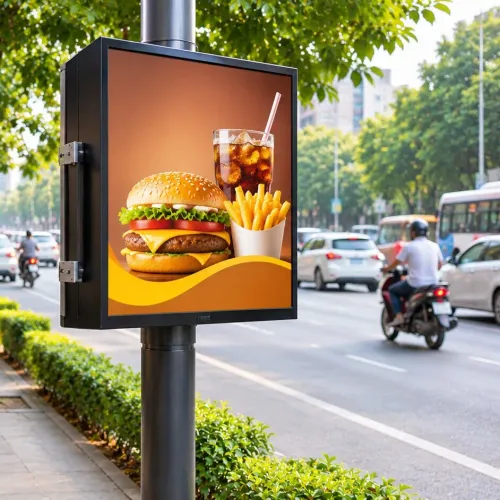
- Use changing-message signs for incidents, closures and temporary routing. Running-letter displays must show short, stable messages; rapid scrolling, flashing and excessive brightness make drivers miss the instruction.
- Install temporary work-zone signs as a coordinated traffic-control system, not permanent signs with a casually changed colour. Update them when lanes, barriers or sight lines move, and remove obsolete signs immediately.
- Place emergency-exit signs on a separate, consistent route. Keep them visible from the approach, free from advertising, and never point drivers toward a construction detour that no longer exists.
Treat visibility as an operating task. Include an inspection and cleaning schedule covering vegetation, parked vehicles, dust, graffiti, faded faces, rotated panels and new street furniture.
At every change, check the approach from a moving vehicle at night and in rain; a sign that remains physically intact can still fail when clutter hides it or an LED display competes for attention.
Frequently asked questions
How do road signs improve traffic safety?
They change road-user behaviour before conflict by reducing speed, identifying hazards, assigning lanes and protecting pedestrians.
Where should road signs be placed?
Place them where drivers have enough sight distance and decision time, before junctions, hazards or lane changes rather than inside conflict areas.
Which features keep road signs visible at night?
Use high-contrast colours, recognised symbols, retroreflective sheeting and suitable illumination, then check visibility from approaching traffic lanes.
What should a safe road sign specification include?
Define the sign size, message, symbol, colour, material, mounting height, lateral clearance, lighting, sight distance and inspection requirements.
Related products
 | Parking LED Sign Board Pixels 10mm Voltage DC 12 V Operating Temperature 20 Degree ~ +60 Degree Owing to the wide experience in this domain, we are instrumental in offering... View product → |
 | Outdoor Signage Board Body Material Aluminum Shape Rectangle Usage Outdoor Enriched by our vast industrial experience in this business, we are involved in offering an... View product → |
 | Outdoor LED Sign Board Usage Outdoor Voltage 110V ~ 220V Material Acrylic Lighting Type LED We have highly acknowledged organization engaged in presenting a remarkable... View product → |
 | Exit LED Sign Board Bulb Type LED IP Rate IP20 In order to keep pace with never ending demands of the customers, our company is instrumental in offering Exit LED Sign... View product → |