A shop sign has only a few seconds to help a passer-by identify your business, understand what you offer and decide whether to look closer. By the end, you will know how to plan the message, size, placement, colour, lighting and materials so the sign works in real viewing conditions and strengthens your brand across locations.
Key takeaways
- Set letter height and contrast for the viewing distance.
- Use a short message customers can decode in seconds.
- Place signs where arriving customers naturally look.
- Plan lighting, materials and maintenance before installation.
Make the Sign Legible Before You Make It Attractive
A distant customer notices a shop sign board when its name can be recognised quickly, not merely when its panel is large or brightly coloured. Shop sign board visibility depends on sign legibility: letter height and stroke width must suit the viewing distance, while contrast separates the message from the background.
1. Stand at the farthest point where a driver, pedestrian or passenger can see the storefront. Check whether the name remains readable at the expected approach speed and viewing angle, then shorten the wording or increase letter scale if decoding takes too long.
2. Test the lettering against its actual panel, wall and surroundings. Dark letters on a light field or light letters on a dark field usually create stronger contrast than similar tones; avoid patterned backgrounds, thin strokes and tight character spacing that merge from a distance.
3. View the sign in daylight and after dark. Use even illumination rather than excessive brightness, because glare can wash out edges and make nearby details harder to read. Confirm that trees, parked vehicles, poles and neighbouring signs do not interrupt the sightline.
A simple full-size paper or digital-distance test exposes weak proportions before fabrication. Increase letter height, stroke width or contrast before increasing the entire sign area; a bigger board with indistinct lettering still fails to attract and inform.
Turn Your Business Name Into a Message People Can Decode Quickly
A passer-by should identify both your business and its offer from the business name signage, not decode a slogan.
Put the name first, then add a short category or service line such as “Fresh breads and cakes” or “Mobile phone repair.” Include a useful action or fact, such as “Walk-ins welcome,” only when it helps someone decide to enter.
Use this checklist to make the shop sign message understandable within seconds:
- State the business name in the largest readable text.
- Add one plain-language description of what you sell or do.
- Use familiar terms such as “Pharmacy,” “Dental Clinic” or “Hardware Store” instead of clever phrases.
- Keep the wording to one main message; a long list of products becomes unreadable at a glance.
- Make the typeface and logo support recognition rather than compete with the words.
- Repeat the same spelling, colours and visual tone across your website, packaging and storefront to strengthen brand identity.
- Check the message from the actual approach path, because a sign that makes sense close up can become meaningless across a road or through a vehicle window.
Do not treat a high-contrast logo as accessible signage. Tactile characters, Braille, contrast, mounting height and placement follow separate rules, including Section 703 of the 2010 ADA Standards where those requirements apply. A promotional sign and an accessibility sign serve different readers.
Choose Sign Size and Placement for the Way Customers Arrive
Choose sign dimensions from the farthest point where customers first get an unobstructed view, not from the shopfront width alone. Measure the viewing distance, approach speed and available viewing time; at 30 km/h, a driver covers 50 metres in about six seconds.
A larger panel will not help if letter height, spacing or contrast remain too weak.
| Arrival route | Best placement | Dimension decision |
|---|---|---|
| Walkers on a narrow footpath | Centre the fascia sign above the entrance, within the natural eye line | Keep the sign compact, but make letters deep enough to read at the opposite side of the footpath |
| Drivers on a busy road | Place the sign perpendicular to traffic or angle it toward the approach lane | Prioritise large letters and a clear silhouette over decorative detail; calculate the structure for wind loads |
| Customers entering from a setback parking area | Mount a sign where the driveway first aligns with the storefront | Increase sign dimensions only after checking the longest viewing distance and sightline obstructions |
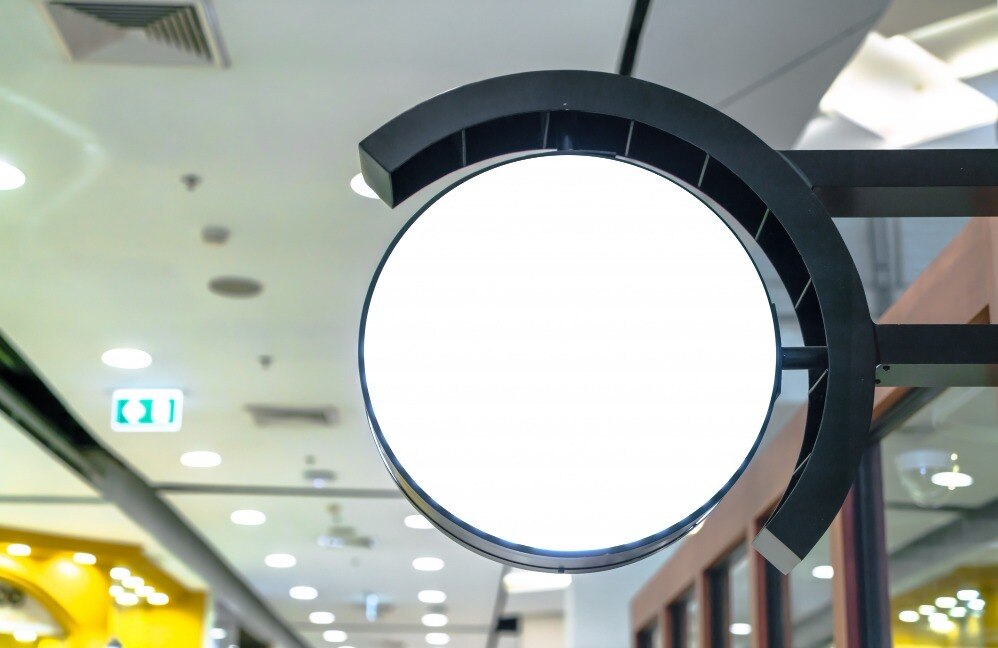
Use a fascia sign when customers face the building. Add a projecting sign board when the frontage is hidden by a setback, adjoining shops or a side-on approach; mount it where it remains visible without blocking pedestrians, vehicles or emergency access.
Check the sightline from the pavement, road lane and parking entrance at eye level. Leave space around the sign, and specify service access, removable faces and safe electrical isolation before fabrication. A sign that requires dismantling the façade for a failed power supply will cost more to maintain than its initial size suggests.
Match the Sign Format to Daylight, Night Visibility and Maintenance
Choose illumination by the hours and setting, not by brightness alone. A sign facing a busy road after sunset needs a different treatment from one read mainly in daylight. Excessive luminance creates glare, makes dark lettering harder to read and can disturb neighbouring properties, so specify dimming or time-based brightness control where required.
| Format | Daylight and night visibility | Appearance and upkeep |
|---|---|---|
| Front-lit sign | Clear in daylight and after dark when external or integrated LEDs light the face | Easy access to the light source; check dirt, shadows and uneven illumination |
| Backlit sign | Strong night presence; daylight impact depends on letter colour and wall contrast | Halo quality depends on standoff, wall texture, wall colour and LED spacing; inspect for bright spots |
| Non-illuminated sign | Reliable in daylight but disappears or weakens at night without nearby lighting | Lowest electrical upkeep; clean the face and check fading, peeling and loose fixings |
| LED display | Highly visible at night and capable of changing messages | Needs programming, pixel or module replacement and brightness control; moving content can weaken a calm brand image |
Approve a lit sample, not only an unlit colour swatch. LED spectrum, diffuser or acrylic transmission, printed ink and ambient light can shift the brand colour. Record the illumination type and correlated colour temperature or chromaticity.
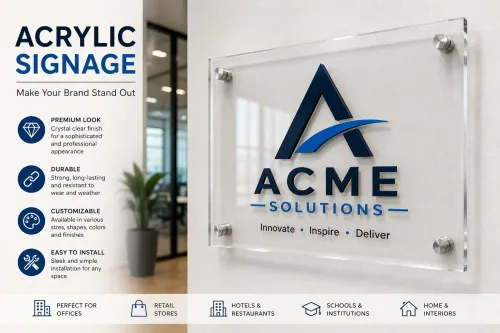
Material affects maintenance too. An acrylic sign board needs thermal-movement allowance; rigid fixings and undersized holes can cause cracks. An aluminium sign board usually suits robust outdoor faces, while an LED display demands access for servicing. Test halo-lit lettering on a small mock-up before production.
Build a Repeatable Brand System, Not a One-Off Shopfront
A scalable sign system fixes the details that must remain unchanged and leaves only site-specific dimensions to vary. Define logo clear space, letter proportions, mounting height, panel material, and separate day and night versions before producing individual outlets. That protects brand consistency without forcing every location into the same physical sign.
Give the fabricator a written production sheet containing:
- Approved logo artwork and minimum clear space
- Colour palette with colour tolerances and specified materials
- Letter depth, stroke widths and viewing orientation
- Illumination type, LED colour temperature and brightness target
- Fixing points, cable routes, drainage and service access
Do not approve colour from an unlit swatch alone. Acrylic, printed ink, diffuser material, LED spectrum and surrounding light combine to change the colour after illumination, so inspect a lit sample at the intended viewing angle.
For halo-lit letters, test standoff distance, LED spacing, wall colour and wall texture with a small physical mock-up; a drawing will not reveal bright spots and dark bands.
Plan LED sign maintenance before the face is sealed. Specify replaceable modules, labelled wiring, accessible power supplies, removable faces and safe service clearance. LM-80 measures LED package performance and TM-21 projects it; neither certifies the finished sign’s calendar life.
Pantone Media Solutions LLP can help translate one approved artwork into outdoor and promotional sign specifications, but you should retain the master file, colour references and maintenance drawings for every future replacement.
Related products
 | Advertising Signage Board Shape Rectangle Condition New Body Material Stainless Steel, Aluminum Thickness 10-20mm Cover Width 30mm We have highly acknowledged organization... View product → |
 | Outdoor Signage Board Body Material Aluminum Shape Rectangle Usage Outdoor Enriched by our vast industrial experience in this business, we are involved in offering an... View product → |
Frequently asked questions
How can you make a shop sign board easier to read?
Set letter height and stroke width for the viewing distance, then use strong contrast between lettering and its background.
What should a shop sign board communicate?
Make the business name prominent and add a short, quickly understood message when customers need more information.
Where should you place a shop sign board?
Choose placement based on how customers arrive, including their approach direction, viewing distance and sightline from roads or walkways.
How do you choose the right shop sign format?
Match the format to daylight conditions, night-time visibility, available lighting, material durability and the maintenance the site can support.
How can shop signage build a consistent brand identity?
Repeat the same colours, typography, logo treatment and visual rules across the shopfront, indoor signs and other branded materials.
Related products
 | Outdoor Sign Board Usage Outdoor Power Consumption 11W,22W Body Material Acrylic Bulb Type LED Being a well-distinguished company in the market, we are into offering... View product → |
 | Promotional Sign Board Pixels 5mm Pixel Density 40000dots/m2 Material Aluminum Lighting Type LED Shape Rectangular We take pleasure in introducing ourselves as leading firm... View product → |
 | Sign Board Lighting Type LED Shape Rectangular Power Source Electric Body Material Aluminium Owing to the rich industrial experience and expertise in this... View product → |
 | Directional Sign Board Lighting Type LED Shape Rectangle Operating Temperature -25Degree-55 Degree We are one of the most reliable companies in this domain and are into... View product → |