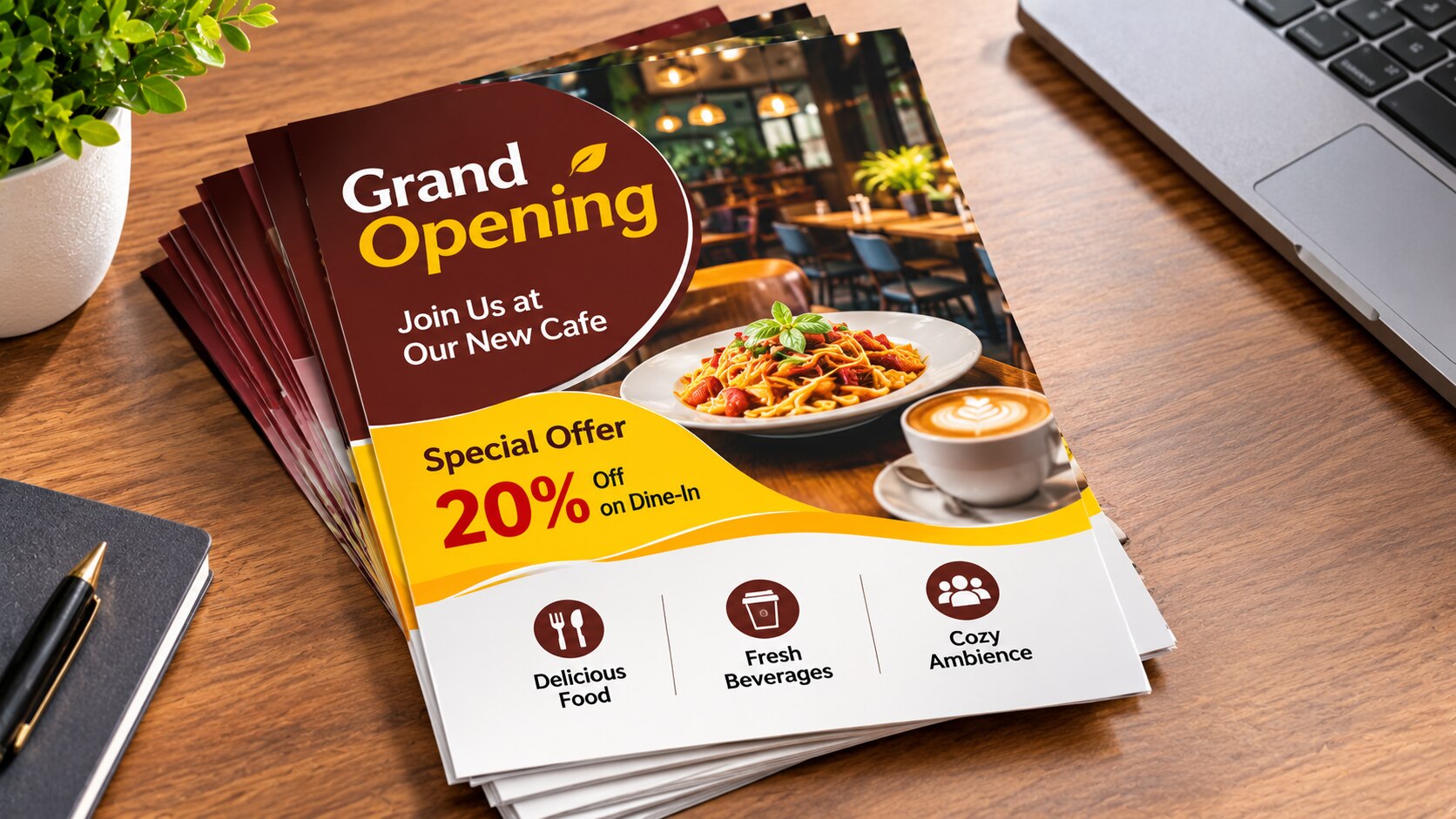
A flyer produces results when the offer, audience, distribution route and response method work as one system. By the end, you will be able to define a campaign objective, choose the right format and paper, write an actionable message, measure local response and recognise when another channel is a better fit.
Key takeaways
- Choose one result and one dominant action before designing.
- Make the offer, audience, location and deadline visible within seconds.
- Match flyer size, paper and finish to how people will receive it.
- Use unique codes, phone numbers or landing pages to measure distribution.
Start With One Objective and One Dominant Action
Decide the single business result the flyer must produce before choosing its headline, image or colours. That result is your flyer marketing objective: attract nearby customers for a walk-in promotion, generate phone calls, collect WhatsApp enquiries, promote an opening, or distribute a discount code.
1. Write the objective as a measurable sentence: “Generate 40 redemptions from households within 2 km during 1–15 December.” A local business promotion becomes easier to judge when you define the audience, area, period and expected response.
2. Choose one dominant action that matches the objective. Use “Visit the store,” “Call now,” “Scan to book,” or “Redeem this code,” not four equally prominent instructions. Supporting contact details can remain in smaller text, but competing calls to action make staff handling and response attribution harder.
3. Attach a specific offer to that action. State the eligibility, expiry date, location, redemption method and exclusions, such as “New customers only,” “Valid until 15 December,” or “Not valid with other offers.” Vague claims like “best price” create disputes at the counter.
4. Create a tracking method before printing. Use a separate code, landing page or offer for each neighbourhood, partner or distribution route, then record copies delivered, copies remaining and the distribution date. Compare responses per 1,000 delivered, not raw totals.
If scanning is the action, keep a quiet zone of at least four modules around every QR code. A border, image or flyer edge inside that margin can stop phones from reading it.
Build a Flyer That Can Be Understood in Seconds
A reader should understand the flyer’s promise, benefit and next step before looking twice. Effective flyer design uses one large flyer headline, a short supporting line and generous space around the flyer offer; decorative elements must not compete with them.
| Element | Clear choice | What goes wrong otherwise |
|---|---|---|
| Headline | “20% off your first car service” | “Great deals” gives no reason to act |
| Benefit | Name the outcome, such as “same-day appointment” | The offer feels interchangeable |
| Proof point | Add a review rating, guarantee or specific experience | The claim lacks credibility |
| Action | Use one dominant instruction: “Scan to book” | Equal calls to call, visit and message split attention |
| Details | Show address, hours, expiry date and eligibility | Customers arrive with questions staff cannot resolve |
Good flyer copywriting makes conditions visible instead of hiding them in tiny type. State the minimum spend, excluded products, redemption method, expiry date and service location; “limited offer” is not enough when staff must decide who qualifies.
Use short lines, dark text on a high-contrast background and body type that remains readable at arm’s length. A5 gives room for proof and directions, while A6 demands tighter editing and less supporting text.
Place contact details beside the action, not in a crowded footer. For a QR code, preserve a quiet zone of at least four modules on every side and keep it away from borders, images and patterned backgrounds. Assign each locality or print batch a distinct code, phone number or landing page so responses remain measurable.
Choose the Size, Paper and Finish for the Distribution Method
A5 suits most handouts because it holds a headline, offer, location and redemption details without becoming awkward to carry. Choose the smaller A6 flyer or DL flyer when people must pocket it quickly, such as vehicle placement or compact counter distribution.
| Format | Recommended specification | Best use |
|---|---|---|
| A5 | 120–170 gsm coated paper; matte finish for readable text | Handouts and door drops |
| A6 | 170–250 gsm card; rounded corners if permitted | Vehicle placement and quick handouts |
| DL | 120–170 gsm; gloss for strong colour, matte for writing | Counter displays and narrow leaflet holders |
| A4 | 170–250 gsm; fold only after checking crease cracking | Counters needing menus, maps or several offers |
| Synthetic sheet | Waterproof polypropylene or polyester; matte laminate | Monsoon handouts, outdoor displays and wet vehicle surfaces |
For counter displays, choose a heavier stock so the flyer stays upright. For door drops, avoid flimsy paper: damp grass, concrete and gates can curl it before the customer reads it. Lamination protects ink and edges, but recipients cannot write easily on a glossy surface and recycling becomes harder.
Your flyer paper quality must match the response task. Use uncoated stock if customers need to note an appointment or phone number; use a wipe-clean finish when rain or handling is the bigger risk.
Ask Pantone Media Solutions LLP for the printer’s written trim specification before submitting artwork. Supply a print-ready PDF with embedded fonts, the defined trim size and 3 mm bleed unless their specification says otherwise; confirm the colour profile and proofing condition too.
Make Local Distribution Measurable
A neighbourhood campaign needs a boundary and a response identifier. Define the area by radius, delivery route, event location, partner outlet, or household profile, then assign that area its own destination or offer. A flyer handed out “near the shop” provides no reliable local comparison.
Give each distribution segment one distinct identifier:
- Neighbourhood: use a dedicated landing page or QR code flyer destination.
- Distribution partner: issue a separate phone number or enquiry form.
- Print batch or shift: use a unique promo code for promo code marketing.
Keep the primary action consistent within each segment: scan, call, visit, or redeem. Multiple competing actions make flyer tracking harder because staff and customers choose different paths. Print the code in a prominent position and ask customers to quote it at checkout or during a phone enquiry.
Record the quantity delivered, quantity remaining, route or outlet, and distribution date or shift. Compare responses per 1,000 flyers delivered, not raw response totals; 40 responses from 1,000 copies is stronger than 50 from 2,000. Add cost per response and revenue by zone to identify profitable areas.
Check every QR destination before distribution. Preserve a clear quiet zone of at least four modules on all four sides, because a code touching a border, image, or patterned background can fail to scan. Compare coded responses with uncoded visits separately so existing customers and organic traffic do not inflate the flyer result.
Compare Flyers With Other Channels Before You Print
Choose a flyer when you need a physical prompt within a defined local area: a nearby shop opening, limited-time offer, event invitation or coupon that people can keep and redeem.
The flyers versus digital ads decision depends on reach control: flyers put the message directly in homes, hands or partner locations without relying on platform delivery.
| Channel | Choose it when | Choose another channel when |
|---|---|---|
| Flyers | You need a tangible offer, route-based coverage and a message people can pass to another household. | Your audience is spread widely or the offer changes daily. |
| Digital ads | You need fast testing, audience targeting, retargeting and immediate traffic to a landing page. | Customers respond better to a physical coupon or live nearby distribution. |
| WhatsApp marketing | You have permission-based contacts and need reminders, replies or repeat purchases. | You need to reach people who have never opted in. |
| Posters, banners and sign boards | You want repeated visibility at one fixed location or along a busy route. | You need detailed information, personal distribution or response tracking. |
| Newspaper inserts | You want broad delivery through a selected publication and a printed offer. | Your campaign needs tight street-level targeting or real-time creative changes. |
Compare local marketing channels using the same offer period and a distinct QR destination, phone number or code for each channel. Record responses per 1,000 delivered or reached; raw scans cannot show which channel produced the sale. Choose another option when you cannot control distribution, identify response or refresh the message quickly enough.
Frequently asked questions
What should a local business flyer aim to achieve?
Choose one business result, such as walk-in visits, phone calls, WhatsApp enquiries, opening attendance or discount-code use, then build the flyer around it.
How can you make a flyer understandable in seconds?
Give the flyer one dominant action and make the offer, audience, location and deadline easy to find at a glance.
How should you choose flyer size, paper and finish?
Match the format and materials to the distribution method, whether you hand flyers out, place them on counters or deliver them locally.
How can you measure local flyer distribution?
Use a unique discount code, phone number, WhatsApp link or landing page for each distribution area or partner.
What should you compare before choosing flyers?
Compare flyers with other channels by objective, audience reach, production effort and whether each channel gives you trackable responses.