
A sign for a roadside shop must solve a different problem from a corridor directory, safety notice, reception logo, or short-term offer. By matching the sign format, construction, lighting, readability, installation method, and maintenance plan to the site, you can compare options on performance rather than material or price alone.
Key takeaways
- Define the sign’s task before choosing its material.
- Match construction to weather, impact risk, weight, and appearance.
- Size lettering and lighting for the actual viewing distance.
- Compare installation, maintenance, warranty, and removal costs together.
Start with the business task, not the board material
Choose the sign by the job it must perform: identify a location, direct movement, warn about danger, or sell an offer. Decide the viewing distance, message-change frequency, and operating hours before choosing a board material.
| Requirement | Best-fit signage format | Message and use |
|---|---|---|
| Storefront identification | Fixed fascia, projecting sign, or illuminated letters | Show the business name, logo, entrance, and opening hours. |
| Wayfinding | Directional panels, suspended signs, or wall-mounted arrows | Use short instructions such as “Reception,” “Lift,” or “Parking,” with consistent arrows. |
| Safety instructions | High-contrast, non-illuminated or internally lit instruction board | State one action per panel, such as “Wear helmet” or “Emergency exit.” |
| Temporary promotion versus permanent storefront signage | Replaceable poster, flex banner, or rigid promotional panel for offers; fixed fascia for identity | Display the discount, product, validity date, and call to action on temporary signs. |
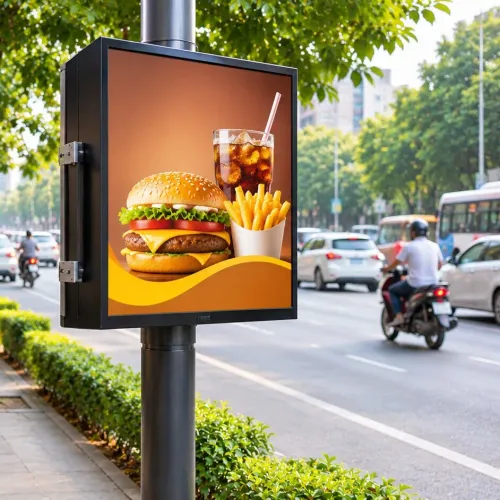
| Roadside visibility | Large, high-contrast fascia, pylon, or front-lit board | Limit the message to the name, category, and one contact detail. |
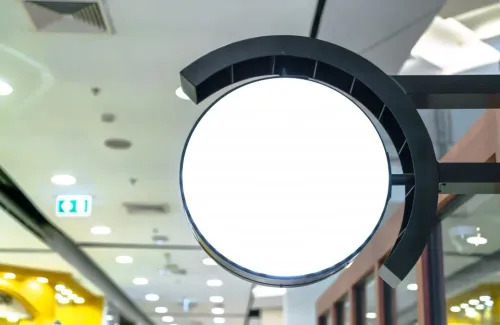
| Reception branding | Logo panel, dimensional lettering, or backlit acrylic feature | Reinforce identity without competing with visitor instructions. |
| Menu display | Illuminated menu board, printed panel, or digital screen | Group items clearly and make prices easy to update. |
Give each board one primary job. A menu that also carries a long brand story becomes unreadable, while a safety panel hidden among promotional graphics can delay the action it communicates.
Approve the actual message at its real viewing distance. Check spelling, phone numbers, QR codes, opening hours, arrows, and language versions before production; correcting a printed board after installation costs more than correcting artwork.
Match construction to weather, impact, weight, and appearance
A light face does not make a light or durable sign. For a projecting, rooftop or parapet installation, check the complete assembly: dead load, wind load, eccentricity, anchors and the wall’s local pull-out capacity.
A large sign can create substantial overturning force even when its board is lightweight; use IS 875 (Part 3) for wind-action design in India.
| Option | Strength and appearance | Best fit and caution |
|---|---|---|
| Aluminum | Light, corrosion-resistant and available in painted or brushed finishes | Storefronts and projecting signs; specify a rigid frame, sealed joints and suitable fasteners |
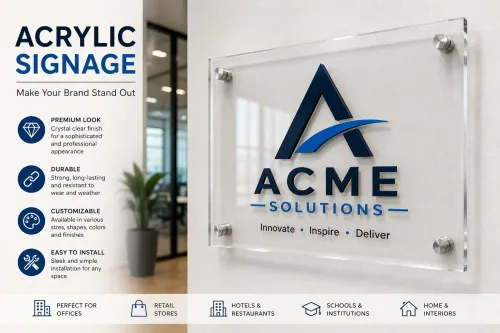
| Acrylic | Glossy, colour-rich and effective for illuminated faces | Reception branding and lightboxes; cast acrylic offers better outdoor stability, while extruded sheet costs less |
| Stainless steel | Heavy, impact-resistant and premium-looking | High-contact entrances and long-life identification; its weight and fingerprints increase installation and cleaning demands |
| ACP panels versus structural frames | ACP provides a flat, light skin; the frame carries the load | Large fascia and rooftop signs; never treat ACP as the structural member |
Outdoor survival depends on details behind the face. Specify a rear enclosure, sealed cable entries, drain paths, weather-resistant fasteners and a mounting frame; a weather-resistant sheet does not make an unsealed cabinet waterproof.
Allow for movement between materials. A 2-metre acrylic face can expand about 5.6 mm across a 40°C temperature swing, so use slotted holes, floating clips or joint clearance instead of rigid fixing to aluminum. In impact-prone locations, protect edges and choose stainless steel or a framed panel over unsupported acrylic.
Choose visibility and lighting from the viewing conditions
Specify the intended reading distance, approach speed and viewing angle before choosing board dimensions. Letter height must also account for typeface, stroke width, contrast and background clutter; the “one inch per ten feet” rule can undersize a roadside sign and overpower a pedestrian setting.
Approve a physical sample from the actual distance, not a drawing alone.
| Option | Best viewing condition | Design and lighting choice | Main limitation |
|---|---|---|---|
| Non-illuminated signage | Daylight, staffed premises, short operating hours | High-contrast printed faces; use reflective signage boards where vehicle headlights provide the light | Weak night visibility without external lighting |
| Front-lit LED | Night viewing from roads or open areas | Deep letters or a cabinet with evenly spaced LED modules and a diffuser | Needs power, maintenance access and glare control |
| Backlit acrylic | Close to medium viewing distance, reception or premium frontage | Translucent acrylic or printed face with matched LED colour temperature | An unlit sample will not reveal colour shifts or hotspots |
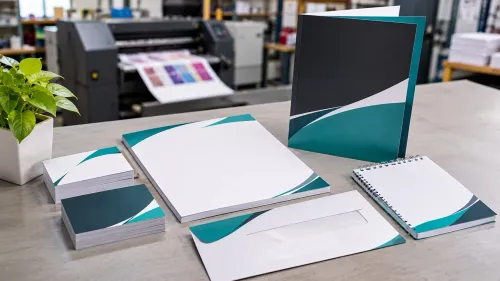
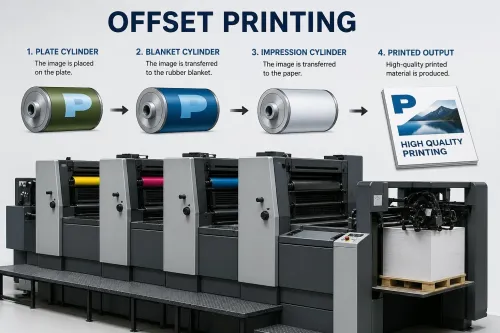
| Printed board | Temporary promotions, menus or frequently changed messages | Choose a matte face to reduce reflections and confirm legibility at the viewing distance | Fading and poor night visibility without added lighting |
For an illuminated sign, approve a lit sample using the proposed LED modules, face thickness, diffuser and dimming level. Then specify the electrical operation:
- Set a photocell, astronomical timer or scheduled dimming so brightness changes between day and night.
- Match LED module spacing to letter depth and face translucency; hotspots waste the advantage of LED.
- Size the constant-voltage power supply for module load, wiring loss, heat and ventilation. Split long runs or increase conductor size when voltage drop causes end-of-run dimming.
- Require an earthed frame, overcurrent protection, weather-protected isolator and suitable cable glands, with a competent electrician coordinating the circuit with the building’s protection.
Verify the installation and compare the complete quotation
A low-cost face can hide an expensive installation. Before approving the drawing, ask Pantone Media Solutions LLP or any supplier to quote the complete assembly: enclosure, frame, anchors, electrical protection, cable routing, access panels and service method.
For rooftop, parapet or projecting signs, require a wind load and dead-load check under IS 875 (Part 3), not just a material description.
- Confirm the mounting hardware matches the wall or structure, including anchor type, pull-out capacity, corrosion resistance and spacing.
- Inspect the proposed weatherproofing: sealed cable glands, covered cable entries, drain paths, sealed access panels and a rear enclosure. An outdoor face alone is not weatherproof.
- Record the enclosure rating. IP65 is dust-tight and protected against water jets; IP66 withstands more powerful water jets. Neither rating permits immersion, and drilling extra holes can compromise it.
- Require a properly earthed metal frame where applicable, overcurrent protection, a weather-protected isolator and a circuit coordinated with the building’s electrical protection. Have a competent electrical professional verify the final connection.
- Put maintenance access in writing: front-access modules or removable faces, labelled power supplies, replaceable LED strings and a safe route to each component.
- Compare warranty duration, response time, excluded damage, cleaning responsibility, inspection frequency and the cost of replacing drivers, LEDs or damaged panels.
| Quotation item | Acceptable detail | Warning sign |
|---|---|---|
| Installation | Labour, lifting equipment, access and reinstatement included | “Installation extra” |
| Electrical work | Glands, earthing, isolator and testing specified | Extension from a lighting point |
| Service | Parts, visits and access method priced | Warranty without response terms |
| Structural work | Frame, anchors and wind load documented | Face material used as the structure |
Related products
 | Outdoor Signage Board Body Material Aluminum Shape Rectangle Usage Outdoor Enriched by our vast industrial experience in this business, we are involved in offering an... View product → |
 | Outdoor Sign Board Usage Outdoor Power Consumption 11W,22W Body Material Acrylic Bulb Type LED Being a well-distinguished company in the market, we are into offering... View product → |
Use a weighted checklist to make the final selection
Give each option a score out of five, multiply it by an agreed weight, and reject any board that fails a non-negotiable requirement. The highest total is not automatically the best choice: a low-cost board that cannot survive rain or cannot be safely installed is a false saving.
- Set the weights before reviewing quotations. A practical starting point is visibility 30%, durability 25%, budget 20%, installation complexity 15%, and maintenance 10%.
- Build a signage comparison table and score every option against the same evidence. Use a physical lit sample for illuminated signs, the exact substrate-and-ink warranty for printed signs, and the proposed fixing method for heavy boards.
- Multiply each score by its weight, then add the results. Record assumptions beside the score, such as “night visibility based on a 10-metre viewing distance”.
- Apply disqualifiers after calculating the total. Reject an outdoor illuminated board if its design omits a properly earthed frame where applicable, overcurrent protection, weather-protected isolation, or suitable cable glands. Have a competent electrical professional check coordination with the building’s protection.
- Choose the runner-up when its evidence is stronger. A slightly lower score with documented colour retention and sealed cable entries is safer than an attractive score based on supplier claims alone.
| Option | Best fit | Reject it when |
|---|---|---|
| Printed ACP | Daytime branding and changing campaigns | You need strong night visibility |
| Illuminated acrylic | Storefront identification after dark | The facade cannot support the frame or wiring |
| Stainless steel | High-impact, premium applications | Weight, glare, or installation effort exceeds the brief |
| Temporary fabric or flex | Short promotions | You need long outdoor service life or sharp close viewing |
Frequently asked questions
How do I choose the right signage board for my business?
Start with the sign’s task: identify a location, direct movement, warn about danger, or promote an offer. Then assess viewing distance, message-change frequency, operating hours, weather, impact risk, and installation conditions.
What factors determine signage board construction?
Choose construction based on exposure to sun, rain, wind, and impact; the board’s weight and mounting surface; required lifespan; maintenance access; and the visual finish you want.
How should I choose signage visibility and lighting?
Base lettering size, contrast, illumination, and viewing angle on the distance, traffic speed, ambient light, and hours when people need to read the sign. Test the design from the real approach path.
What should a signage quotation include?
Compare the complete cost, including board materials, artwork, fabrication, lighting, wiring, brackets, transport, installation, permits, warranty, maintenance, and future message changes.
Related products
 | Outdoor LED Sign Board Usage Outdoor Voltage 110V ~ 220V Material Acrylic Lighting Type LED We have highly acknowledged organization engaged in presenting a remarkable... View product → |
 | Advertising Signage Board Shape Rectangle Condition New Body Material Stainless Steel, Aluminum Thickness 10-20mm Cover Width 30mm We have highly acknowledged organization... View product → |
 | Promotional LED Sign Board Material Aluminum, Acrylic Shape Rectangle Power Consumption 12V-48V Installation Wall mounting Thickness 20-50 mm We are one of the most... View product → |
 | Sign Board Lighting Type LED Shape Rectangular Power Source Electric Body Material Aluminium Owing to the rich industrial experience and expertise in this... View product → |