A retail sign can be bright and attractive yet fail because shoppers see it too late, cannot read it from the corridor, or have no clear next step. By mapping each branding touchpoint to a shopper objective, selecting the right format and testing it in the real mall environment, you can improve recognition, action and measurable engagement without breaching tenant-design rules.
Key takeaways
- Map branding touchpoints from entrances, parking routes and drop-off areas.
- Match each sign to the shopper’s next decision and viewing distance.
- Use short, high-contrast messages with one clear action.
- Inspect sign brightness, damage and sightlines before visibility drops.
Build a Visibility Path from the Mall Entrance to the Store
Treat the route to the shop as a chain of mall branding touchpoints, not a single storefront sign. A fascia sign seen only after shoppers reach the unit cannot repair poor visibility along parking routes or from drop-off areas.
- Parking routes and drop-off areas: introduce the brand before shoppers enter, using signs that remain legible from a moving vehicle or walking approach.
- Mall entrances: create the first pedestrian recognition point and direct shoppers toward the correct zone, floor or wing.
- Directories and atriums: reinforce the store name, level and nearby landmark where shoppers pause to orient themselves.
- Pillar wraps, lift lobbies and escalator panels: repeat the identity along routes with predictable dwell time and viewing angles.
- Food-court zones and kiosk surrounds: reach shoppers who are already stationary and give them a reason to visit another area.
- Corridor sightlines: place directional branding before a turn, not after it, so the arrow supports the next route decision.
- Storefront fascia: repeat the same name, colours and visual cue at the destination for instant recognition.
- Windows and the entrance threshold: confirm that shoppers have found the right store and prompt entry with a current offer or product message.
Keep wayfinding visually separate from changing promotional graphics. Consistent arrows, terminology and placement help shoppers move faster, while campaign messages can attract attention without weakening route guidance. Check every touchpoint from actual approach distances, viewing angles and peak glare; glossy acrylic or exposed LED hotspots can make a bright sign harder to read.
Track pass-by-to-entry rate, offer redemptions or QR scans rather than mall footfall alone.
Match Each Location to the Shopper’s Next Decision
A distant message must win attention; a route message must remove uncertainty; a close-range message must make acting easy. Match the placement to what the shopper can see, how fast they are moving and whether they have time to stop.
| Objective | Best placement and shopper condition | Message job |
|---|---|---|
| Awareness and store discovery | Entry or atrium sightline, where movement is steady and viewing distance is long | Establish the name, category and visual identity before the shopper chooses a route |
| Wayfinding | Decision points, such as a corridor junction or lift lobby, where shoppers slow to orient themselves | Use one clear destination, a consistent arrow and the mall’s approved terminology |
| Action | Storefront approach, kiosk surround or food-court zone, where dwell time is longer | Present a product launch, seasonal promotion, offer or QR code with an immediate next step |
Keep promotional artwork out of the visual zone reserved for wayfinding. Changing campaign graphics beside directional arrows can delay route decisions, while inconsistent wording can send shoppers past the store.
Movement changes the reading distance. A shopper crossing an atrium needs a short headline and strong contrast; someone waiting near an escalator can absorb a product benefit. Check the view from the walking direction, not only from directly in front of the sign.
Measure each location against its intended decision: recall for awareness, route completion for wayfinding, and pass-by-to-entry rate, offer redemption or QR scans for action. Mall footfall alone cannot show that the branding changed behaviour.
Choose the Sign Format for Distance, Duration and Message Frequency
Choose the format by matching viewing distance, shopper dwell time and how often the message changes. A permanent store identifier needs different treatment from a ten-second promotion or a route instruction.
| Format | Best use | When it applies |
|---|---|---|
| Storefront signage | Store identity and recognition | Use at the entrance where shoppers are close enough to read the name and confirm they have arrived. |
| Illuminated fascia signs | 24-hour, high-contrast store identification | Use on a shopfront competing with bright mall lighting or evening traffic. |
| Backlit panels | Static campaigns and product imagery | Use where shoppers approach from a corridor and need a readable message at medium distance. |
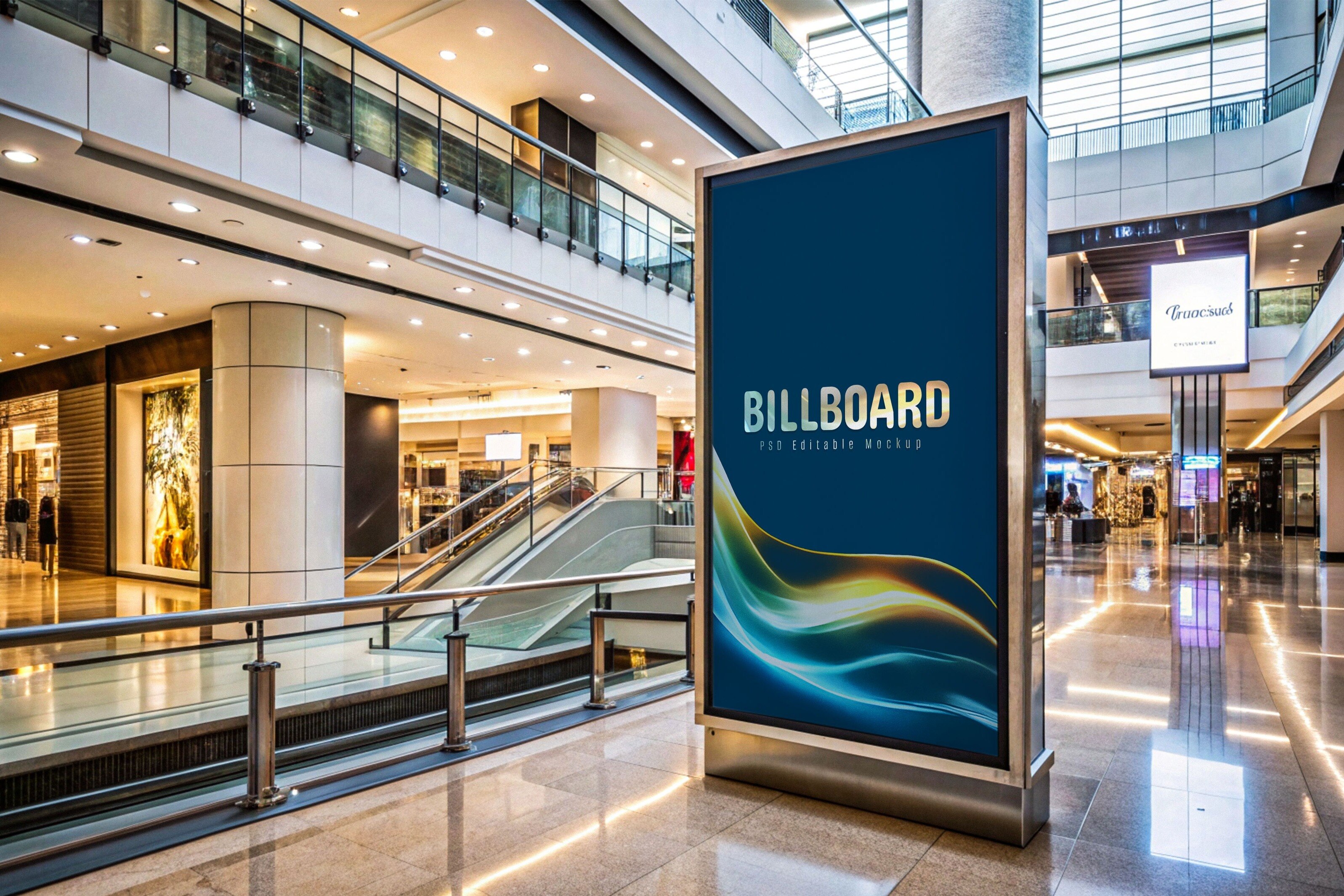
| Digital LED screens | Frequently changing promotions, launches and video | Use where dwell time supports repeated exposure; control brightness for daytime, evening and low-traffic periods. |
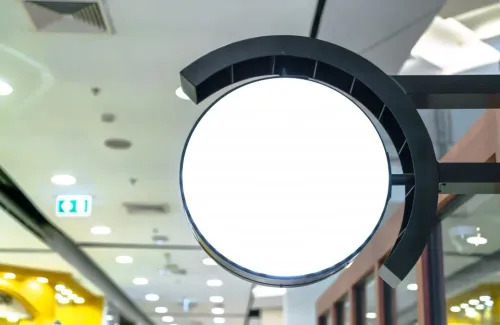
| Hanging signs | Overhead store discovery | Use above corridors or intersections when sightlines are blocked by crowds or displays. |
| Pillar branding | Repeated campaign awareness | Use along a route, atrium or lift lobby where shoppers pass several times. |
| Floor graphics | Short-range prompts and route cues | Use near escalators, queues or entrances; worn graphics lose impact quickly. |
| Window graphics | Offers and product detail | Use at the storefront to convert attention into browsing or entry. |
| Directional signs | Route guidance | Use with fixed arrows, terminology, placement and contrast; do not mix changing promotions into this visual zone. |
Approve the design with an on-site visibility check at the real approach distance and viewing angle. Test peak glare, nearby illuminated signs, acrylic reflections and LED hotspots, then specify cleaning, driver access, module replacement and water-ingress checks.
Design Messages That Shoppers Can Read and Act On
Visibility becomes engagement when a shopper can understand the message and complete the next step without stopping to decode it. Design readable mall signage for the actual approach distance, viewing angle and ambient light, not for a desktop proof.
A bright sign can still fail when glossy acrylic reflects ceiling lights or exposed LEDs create hotspots.
- Use one primary message and one call to action, such as “Try the new collection” or “Turn left for fitting rooms.”
- Set font size from the farthest recognition point, then test the words at that distance. Thin fonts and tightly spaced letters disappear first.
- Create strong contrast between lettering and background; do not rely on colour alone to distinguish the message.
- Keep the logo scale large enough for recognition, but do not let it crowd out the offer, arrow or location.
- Keep promotional artwork outside the mall’s fixed wayfinding zone. Changing campaign messages beside inconsistent arrows can delay route decisions.
- For QR campaigns, use a campaign-specific URL, tagged analytics, a mobile page that works on the mall network and a short-URL fallback.
Measure behaviour at the branded location, not exposure alone. Compare a baseline period with the campaign period and separate results by placement.
| Objective | Useful measure | Evidence of action |
|---|---|---|
| Store discovery | Pass-by-to-entry rate | More visitors enter after passing the sign |
| Promotion | Offer redemptions | Shoppers use the displayed code or phrase |
| Digital response | QR scans and tagged sessions | Traffic comes from that specific placement |
| Conversion | Assisted sales and repeat visits | Engagement continues beyond the first visit |
Approve, Build and Maintain Branding Without Losing Visibility
Get mall branding approval before artwork goes to fabrication. Ask the landlord for the tenant handbook, approved sign zones, permitted dimensions, fixing method, operating hours, illumination limits and restrictions on hanging, floor or façade branding.
- Confirm these items in writing:
- Structural details: fixing points, panel weight, wind exposure, substrate condition, access equipment and load limits. Never attach a heavy sign to cladding without an engineer-approved support detail.
- Electrical load: voltage, circuit capacity, isolator location, cable routing, timer settings and emergency shut-off access. An overloaded circuit can trip neighbouring signs or create a maintenance hazard.
- Fire-safety documents: material flame-spread and smoke test reports, cable specifications, fixing details and clearances from sprinklers, emergency exits, fire extinguishers and hydrants. Foam board, acrylic, PVC, aluminium composite panels and printed films are not interchangeable.
- Accessibility: tactile characters, contrast, mounting height, approach clearance and reach range under the mall’s adopted standard. A small Braille label does not make an ordinary sign accessible.
- Maintenance: front or rear access, LED and power-supply replacement, cleaning method, spare panels and safe isolation procedures.
Approve a photometric or on-site test at the real approach distance. Check viewing angles, peak glare, nearby illuminated signs and acrylic reflections; exposed LED hotspots can reduce legibility despite high brightness.
For fabrication, Pantone Media Solutions LLP can use the approved fixing and lighting specification rather than treating a generic outdoor print rating as proof of mall durability. Record ink, substrate, laminate, edge sealing and replacement assumptions before installation.
Related products
 | Promotional Sign Board Pixels 5mm Pixel Density 40000dots/m2 Material Aluminum Lighting Type LED Shape Rectangular We take pleasure in introducing ourselves as leading firm... View product → |
 | Promotional LED Sign Board Material Aluminum, Acrylic Shape Rectangle Power Consumption 12V-48V Installation Wall mounting Thickness 20-50 mm We are one of the most... View product → |
Frequently asked questions
How can mall branding guide shoppers from the entrance to a retail store?
Build a sequence of touchpoints across entrances, parking routes, drop-off areas, corridors and the storefront so each sign confirms the next direction.
How should retailers match branding locations to shopper decisions?
Place directional signs where shoppers decide where to turn, category or promotional signs before product-selection decisions, and storefront branding at the final arrival point.
Which sign format should a retail store use in a mall?
Choose the format according to viewing distance, how long shoppers remain in view and how frequently they encounter the message; use large directional signs for distance and concise storefront signs for close viewing.
How can mall signs make messages easier to read and act on?
Use a short message, strong contrast, readable type, clear hierarchy and one action, then test visibility from the actual shopper route.
What should retailers check before approving and maintaining mall branding?
Confirm mall approvals, production details, installation access, lighting, sightlines and maintenance responsibilities, then inspect signs for damage, dirt, fading and obstruction.
Related products
 | Backlit Sign Board Promotional Backlit Sign Board ₹ 200/Square FeetGet Latest Price Lighting Type LED Body Material Aluminum Brightness 2000-4000LUX Power AC110V-240V,... View product → |
 | Outdoor LED Sign Board Usage Outdoor Voltage 110V ~ 220V Material Acrylic Lighting Type LED We have highly acknowledged organization engaged in presenting a remarkable... View product → |
 | Advertising Signage Board Shape Rectangle Condition New Body Material Stainless Steel, Aluminum Thickness 10-20mm Cover Width 30mm We have highly acknowledged organization... View product → |
 | Directional Sign Board Lighting Type LED Shape Rectangle Operating Temperature -25Degree-55 Degree We are one of the most reliable companies in this domain and are into... View product → |