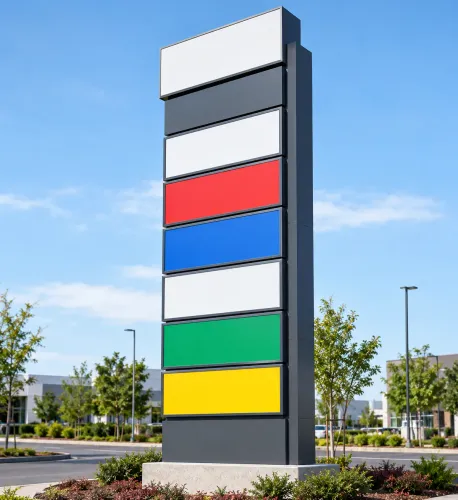
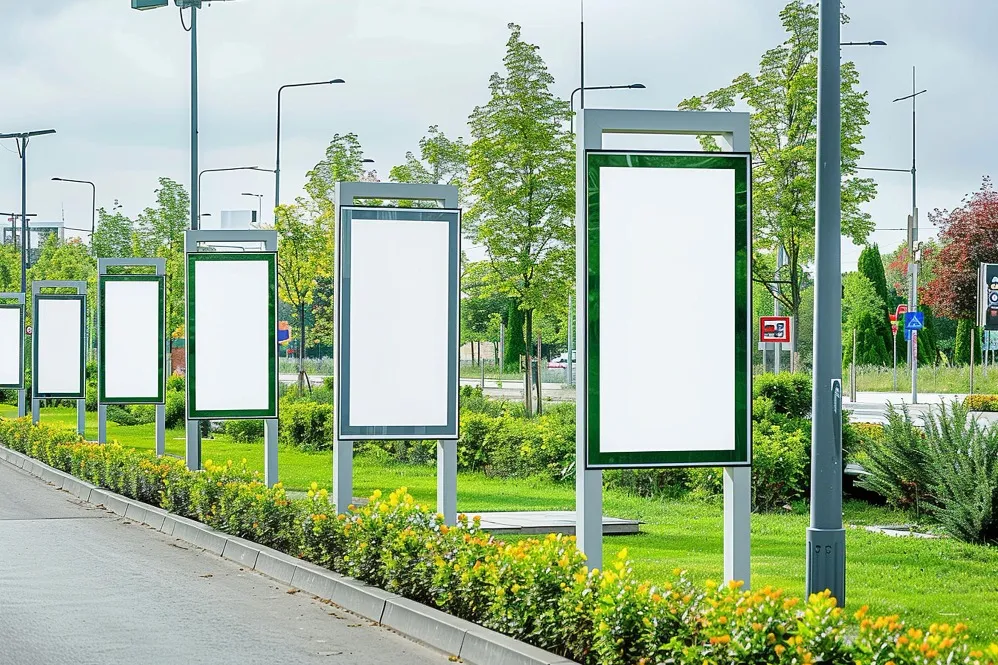
Pole kiosk advertising places brand communication directly along roads, commercial stretches, event routes, and other high-movement areas. Because the format is generally viewed for a short period, its effectiveness depends on quick communication rather than detailed information.
For businesses planning outdoor visibility campaigns in Pune, pole kiosks can support local awareness when location, design, repetition, and message clarity are handled carefully.
Design for a Few Seconds of Attention
People rarely stop to study a pole kiosk.
Most viewers are walking or travelling in vehicles, which means the communication needs to work quickly.
A practical design normally focuses on:
- One primary message
- Strong brand identification
- Large readable typography
- Simple imagery
- Clear visual hierarchy
- Limited supporting information
Trying to reproduce a brochure on a kiosk usually reduces effectiveness.
Repetition Creates Route Visibility
One advantage of pole kiosk campaigns is repeated exposure.
A person travelling along the same road may encounter multiple units carrying a consistent message. This can improve recognition without requiring every kiosk to communicate something different.
Maintaining a consistent design across the route is therefore often more effective than using unrelated creative layouts.
Location Should Match the Audience
High traffic alone does not guarantee relevance.
A campaign should consider who actually travels through the selected area.
A restaurant may benefit from visibility near commercial and residential movement corridors. An event organizer may prioritize routes leading toward the venue. A business-to-business service may focus on areas with relevant office or industrial audiences.
Local media planning should therefore consider audience movement rather than only traffic volume.
Make Branding Instantly Recognizable
Brand name, logo, colours, and message should work together.
If the viewer remembers the offer but cannot identify the advertiser, the communication has not done its full job.
Businesses should avoid placing the logo in a small corner simply because that layout resembles other advertising formats.
Use Campaign-Specific Messages
Pole kiosks can support:
- New store announcements
- Product launches
- Events
- Seasonal campaigns
- Local brand awareness
- Directional communication
- Institutional campaigns
The message should reflect the campaign objective.
For example, an event campaign may emphasize the event name and date, while a new retail outlet campaign may prioritize brand name and location.
Production Quality Affects Perception
Outdoor advertising faces dust, sunlight, wind, rain, and regular environmental exposure.
Poor print quality, loose mounting, faded graphics, or damaged displays can affect how the advertised brand is perceived.
Campaign planning should therefore include production and installation quality rather than focusing exclusively on creative artwork.
Measure More Than Immediate Enquiries
Not every outdoor campaign generates an enquiry that can be directly attributed to one kiosk.
Businesses can also evaluate campaign performance through branded search activity, store visits, promotional codes, event registrations, landing-page activity, or increased local recognition.
Pantone Media Solutions LLP supports outdoor advertising, signage, printing, and branding requirements for organizations planning physical visibility across Pune.
Pole kiosk campaigns work best when they respect the realities of outdoor viewing. Simple communication, relevant routes, repeated visual identity, appropriate production, and a clear campaign purpose can make the medium far more effective than filling every available space with information.
Keywords