Glass has become common in modern offices, retail stores, clinics, hotels, restaurants, and commercial interiors. It creates open spaces and allows natural light to move through the environment, but extensive glass can also introduce challenges involving privacy, visibility, branding, and decoration.
Glass film offers a practical way to modify these surfaces without permanently replacing the glazing.
Where Can Glass Film Be Used?
Commercial applications can include:
- Office partitions
- Meeting rooms
- Conference spaces
- Cabin doors
- Storefront glass
- Reception areas
- Clinics
- Hotels
- Restaurants
- Educational facilities
Different applications require different levels of visibility and graphic treatment.
Privacy Is a Common Requirement
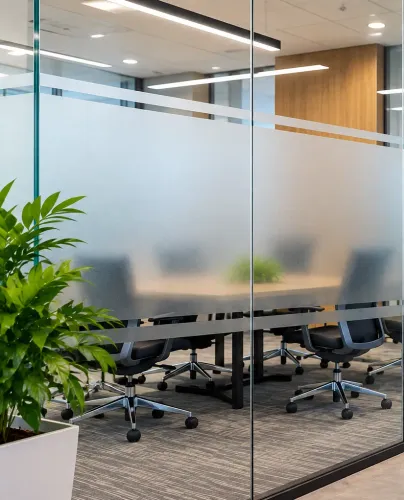
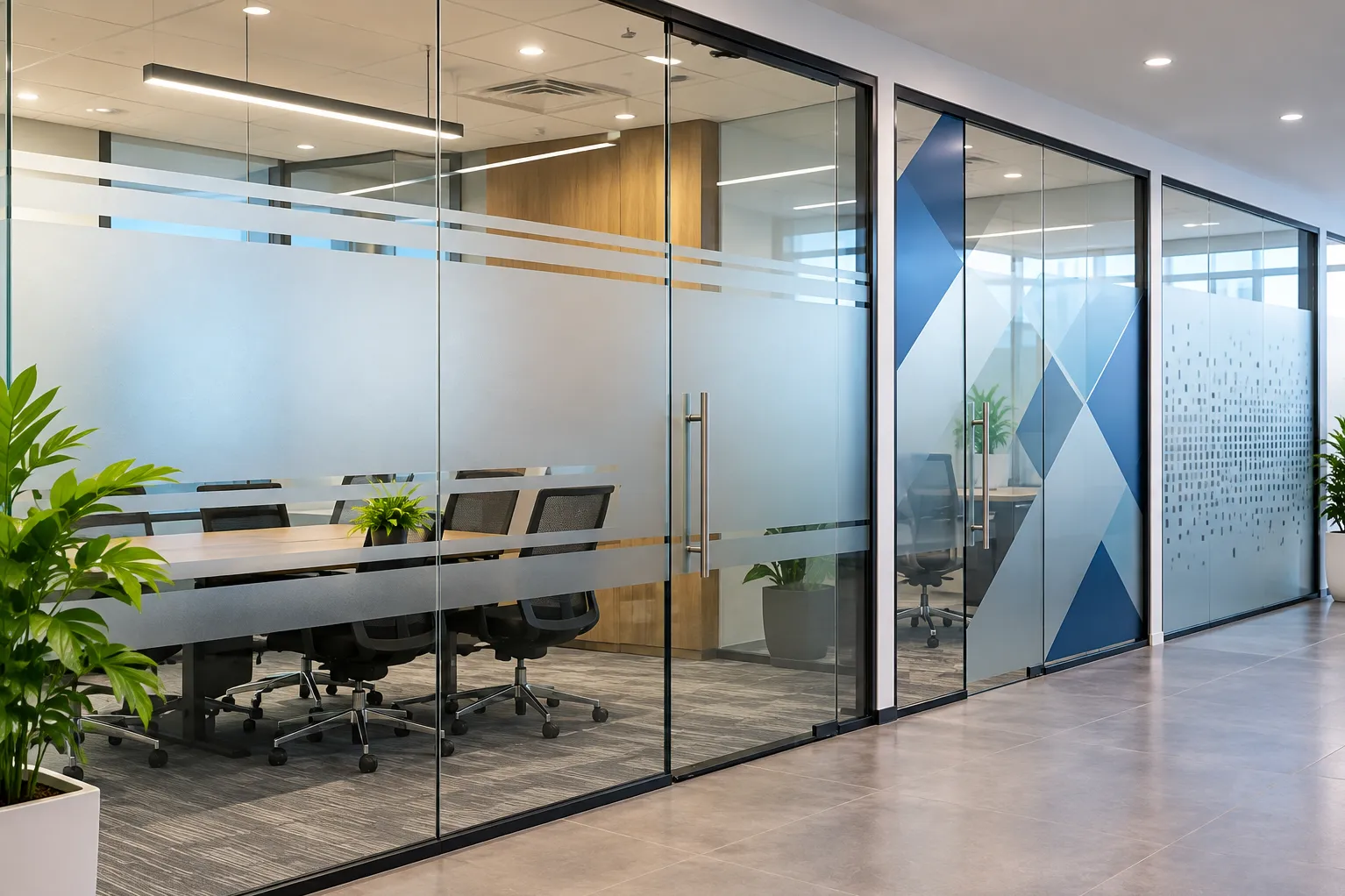
A transparent meeting room may look spacious but provide little privacy during discussions.
Similarly, cabins and consultation spaces may require visual separation without completely blocking available light.
Film can create partial or more extensive screening depending on the design.
Instead of covering an entire glass panel, businesses can also apply privacy bands at eye level where that is sufficient for the space.
Glass Can Become a Branding Surface
Large glass partitions are often underused branding opportunities.
Company logos, patterns, brand elements, graphic bands, or custom designs can be incorporated into glass-film applications.
The important point is restraint.
Office branding should support the environment rather than make every partition visually dominant. Repeating subtle brand elements can sometimes produce a more professional result than applying oversized logos to every surface.
Safety Visibility Should Not Be Ignored
Very clear glass can sometimes be difficult to notice.
Appropriate manifestation graphics or bands can make glass partitions more visible to people moving through the space.
This is particularly useful around doors, entrances, and high-traffic interior areas.
The graphics can be functional while still fitting the overall visual identity.
Measure Every Panel
Glass panels that appear identical may have small dimensional differences.
Accurate site measurement is important, especially when graphics need to align across multiple panels.
Installers should also identify handles, hinges, joints, frames, and other elements that affect application.
Consider Future Changes
Commercial interiors change over time.
Departments move, tenants change, brands refresh their visual identity, and promotional requirements evolve.
Film can provide flexibility in environments where businesses do not want to permanently alter the underlying glass.
This makes it relevant for rented offices and frequently updated commercial spaces.
Installation Quality Is Highly Visible
Glass exposes imperfections easily.
Bubbles, alignment problems, poorly finished edges, contamination beneath the film, or mismatched panels can be noticeable, particularly in well-lit interiors.
Surface preparation and careful installation therefore matter significantly.
For corporate offices and commercial premises across Pune, professional glass-film planning should consider privacy requirements, brand guidelines, panel dimensions, lighting, and how people move through the space.
Pantone Media Solutions LLP provides signage and branding solutions that include applications for commercial glass surfaces.
Glass film can perform several roles at once: creating privacy, improving glass visibility, supporting branding, and adding visual structure to interiors. The best result comes from identifying the functional requirement first and then selecting a design that complements the architecture.
Keywords